
Materials
The Golden Rule of Tilework
What Do Tiled Floors and Medieval Cathedrals Have in Common?

As long as the forces inside the structure remain compressive, the cathedral stands. Once tension appears, cracks begin to develop. Long before engineers described these relationships mathematically, builders had discovered them through experience and learned how to work with them.
In a sense, the Gothic cathedral can be understood as a remarkably sophisticated application of this very simple idea.
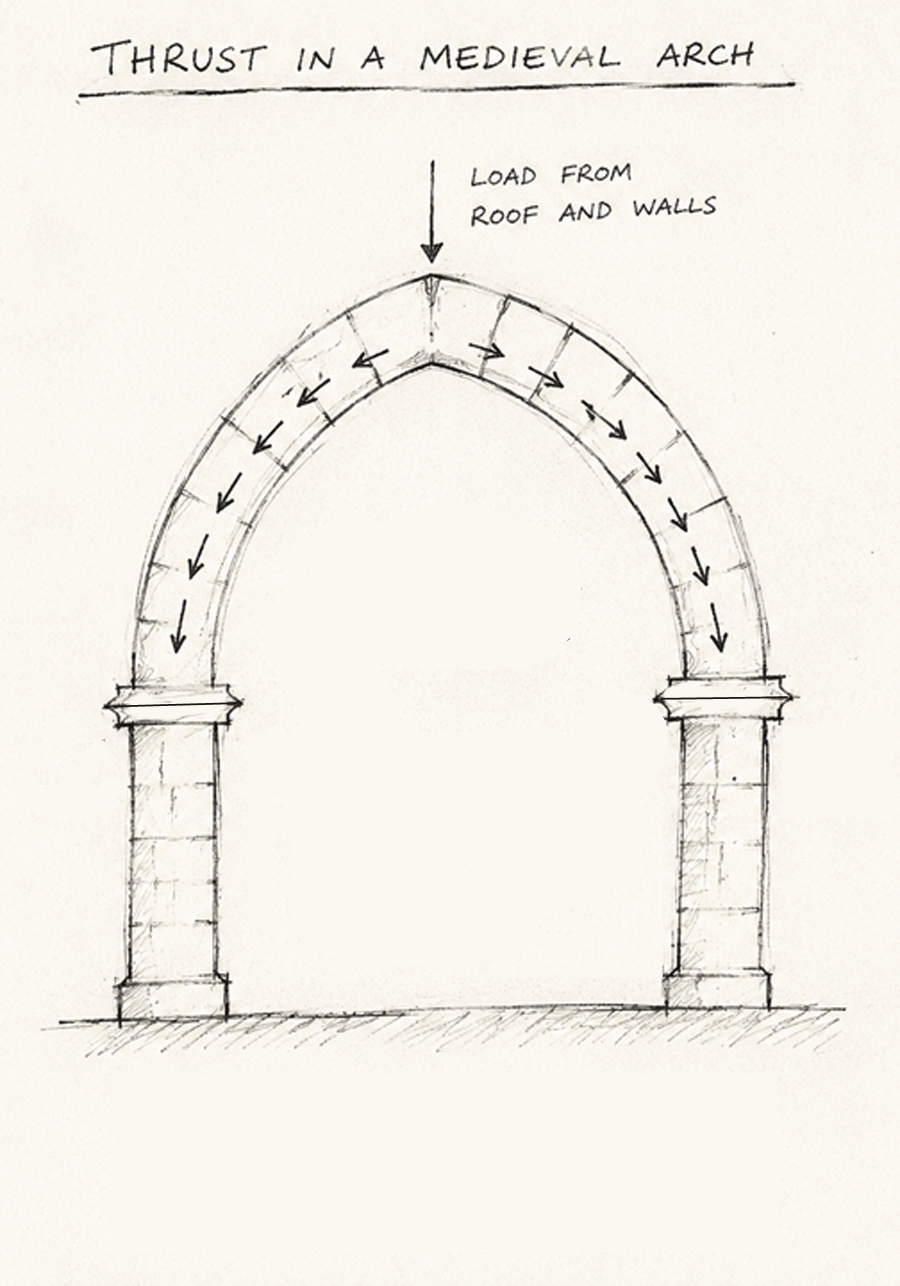
The resultant force (the line of thrust) must stay within the masonry.
Tilework is organised around exactly the same principle.
Ceramic, porcelain, terracotta and natural stone tiles are enormously strong under compression. Yet, like the masonry of a cathedral, they tolerate very little tension.
Cracked tiles are rarely crushed. They usually break because something has caused them to bend.
Uneven Support
Imagine a tile spanning a small hollow beneath it.
The tile behaves like a miniature bridge. When somebody walks across it, the upper surface is compressed, but the underside is pulled into tension.
That tension is what causes cracks.
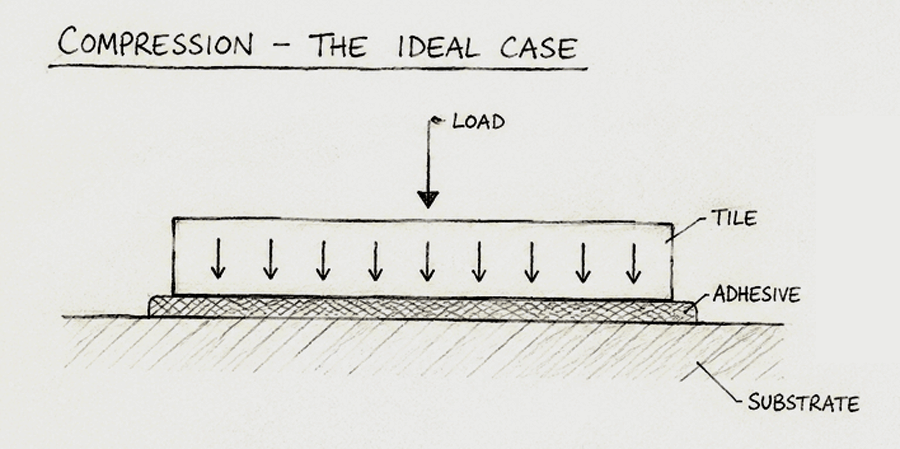
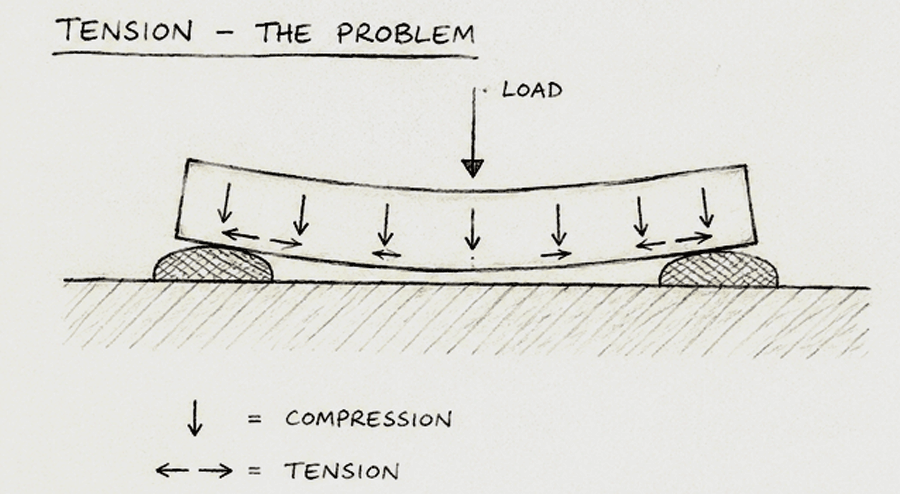
This is why a tiler wants the floor level before tiling begins. The purpose is not cosmetic. The aim is to provide continuous support beneath every tile and eliminate voids.
In theory, small differences in height can be corrected with tile adhesive during installation. This may work with one or two tiles. Across an entire floor, however, it often creates hidden voids and uneven support. For this reason, the substrate itself is normally levelled before tiling begins.
Why Large Tiles Demand Better Preparation
Large-format tiles are not inherently weaker than smaller tiles. They are simply less forgiving.
A small tile spanning a hollow behaves like a short bridge. A large tile behaves like a longer bridge. The longer the span, the greater the bending forces and the greater the tension created within the tile. As tiles become larger, small irregularities in the floor that would have been insignificant with smaller formats become much more important.
There is a certain irony here.
For most of history, tiles were relatively small. Partly this reflected the limitations of manufacturing technology. Traditional ceramic tiles rarely approached the sizes that are common today.
Modern manufacturing has solved that problem. We can now produce large porcelain tiles and slabs with remarkable precision. Yet by making larger tiles possible, modern technology has also made the tiler's job more demanding.
What would have been perfectly acceptable beneath a traditional tile may no longer be acceptable beneath a modern large-format tile.
In a sense, progress has reduced the margin for error. Modern tiles are better. Installing them has become harder.
Movement in the Structure
Buildings move.
Timber expands and contracts with changes in humidity. Screeds expand and contract with temperature. Even masonry buildings experience small movements over time. If these movements are transferred directly to the tiles, tension develops and cracks may appear.
Traditional builders often dealt with this problem by separating the tiled surface from the structure beneath. In some countries, tiles were laid on a bed of sand, allowing the building to move without dragging the tiles with it.
Modern British practice achieves the same objective in a different way. Decoupling membranes create an intermediate layer between the substrate and the tiles, reducing the amount of movement transmitted to the tile covering.
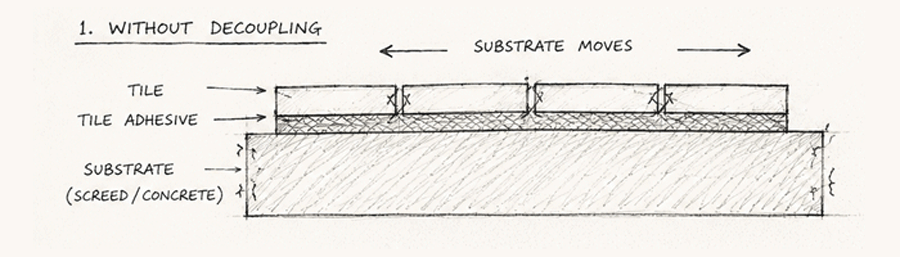
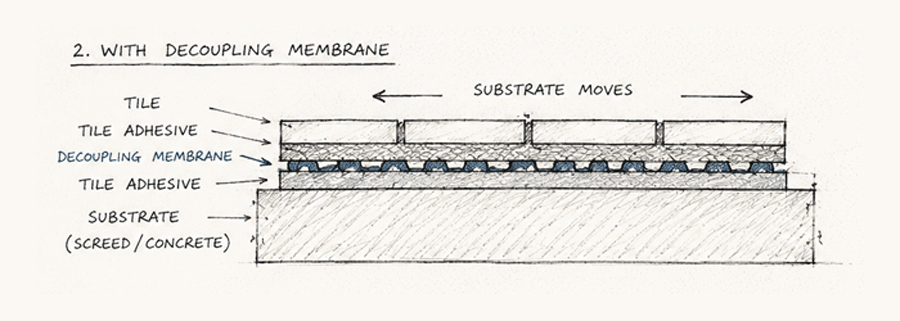
Movement joints follow the same principle. Rather than resisting movement, they provide controlled locations where movement can occur safely.
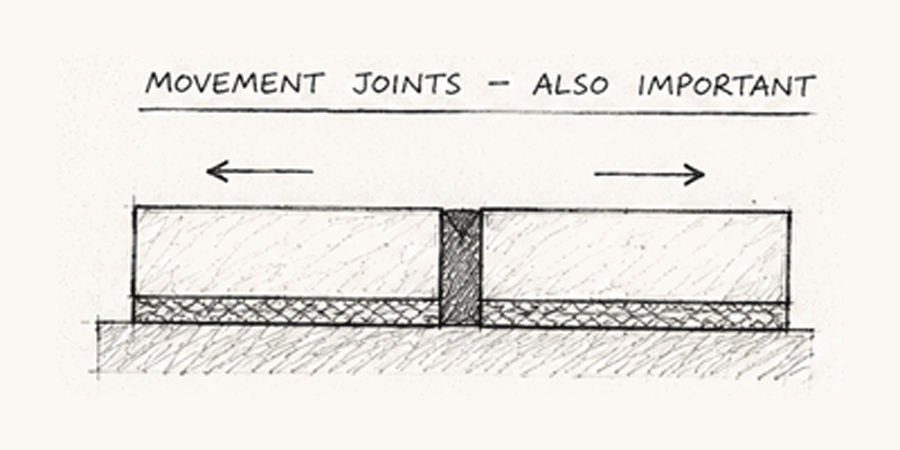
Some modern adhesives also contain elastomeric materials which allow them to absorb a degree of movement and bridge minor cracks.
Preparation Is Structural
People sometimes assume that floor preparation is cosmetic.
In reality, its purpose is structural.
When a tiler asks for floor preparation, he is not trying to make the job more complicated. He is trying to ensure that the tiles spend the next several decades doing what stone does best: carrying loads in compression rather than tension.
Eight hundred years separate a Gothic cathedral from a modern tiled floor. Yet both depend on the same principle.
All compression, no tension.