
Form
The Language of Edges
How tile edges shape light, joints, and precision

A tiled wall or floor is never defined by colour or pattern alone.
As strange as it may sound, it is the edge of a tile that determines whether an installation feels quiet or crisp, tactile or mechanical, forgiving or strict.
Edges influence the visibility of joints, the sharpness of geometry, the way light settles across the surface, and even whether a room appears calm or restless.
Fortunately, for our purposes, most tile edges can be reduced to four main categories.
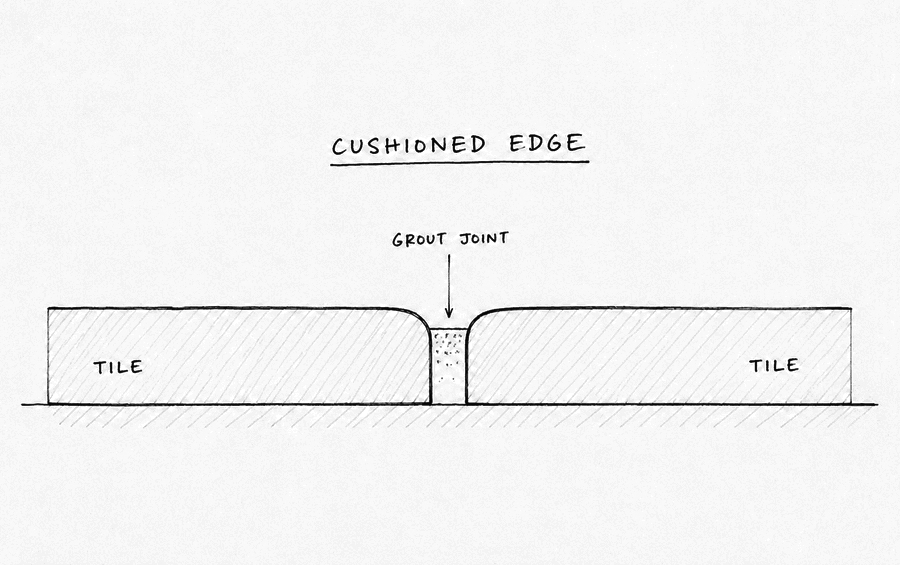
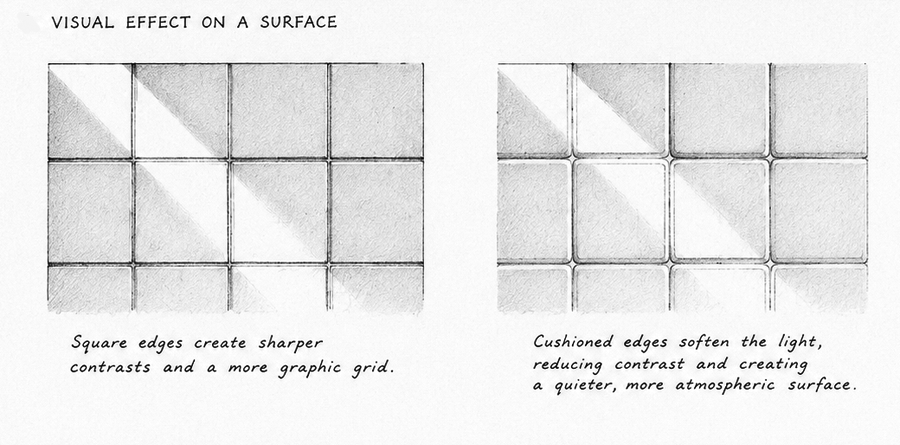
The shadows become softer, the joints less severe, and the grid itself quieter.
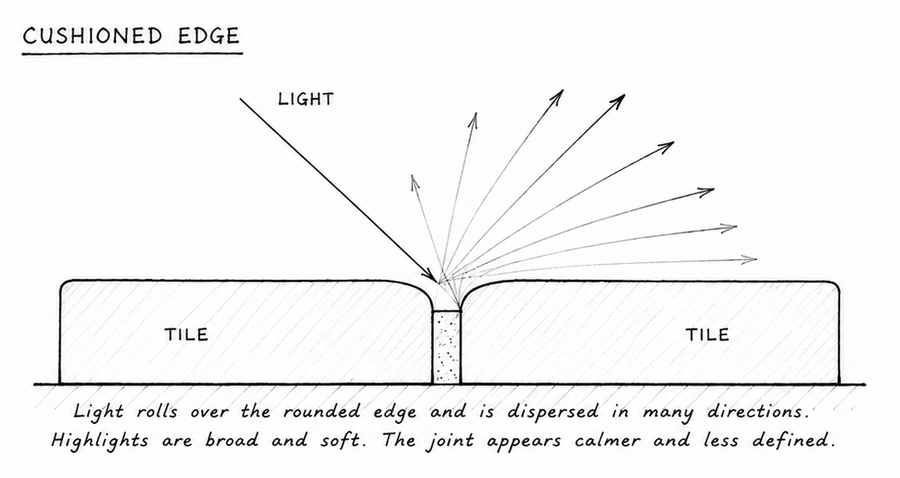
Because of this, cushioned edges tend to produce surfaces that feel calmer and more forgiving.
Small irregularities in alignment, lighting, and glaze variation are absorbed naturally rather than emphasised. The surface appears less rigid and less mechanically defined.
Grout visually merges into the tile surface. Even dark grout tends to appear softer because the transition is rounded.
The effect becomes especially noticeable with glossy glazes. On sharp square edges, reflections tend to stop suddenly, accentuating the geometry of the grid. On cushioned edges, light rolls around the curve, creating subtler highlights and a softer transition from tile to grout.
Historically, cushioned edges emerged largely because traditional ceramic manufacturing was far less precise than modern industrial production.
Slightly softened edges concealed minor variations in tile size and reduced chipping during firing and installation. Over time, however, the softened edge became an aesthetic quality in its own right rather than merely a practical necessity.
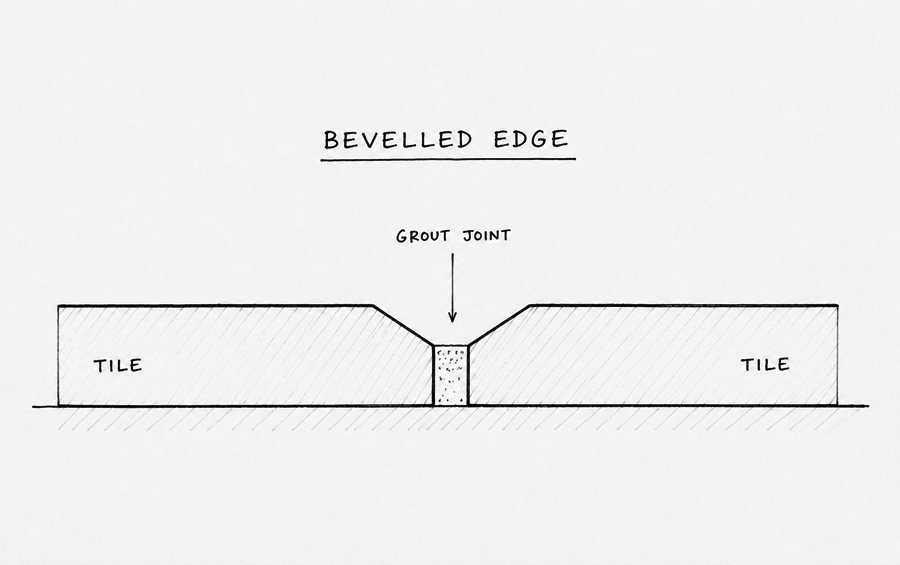
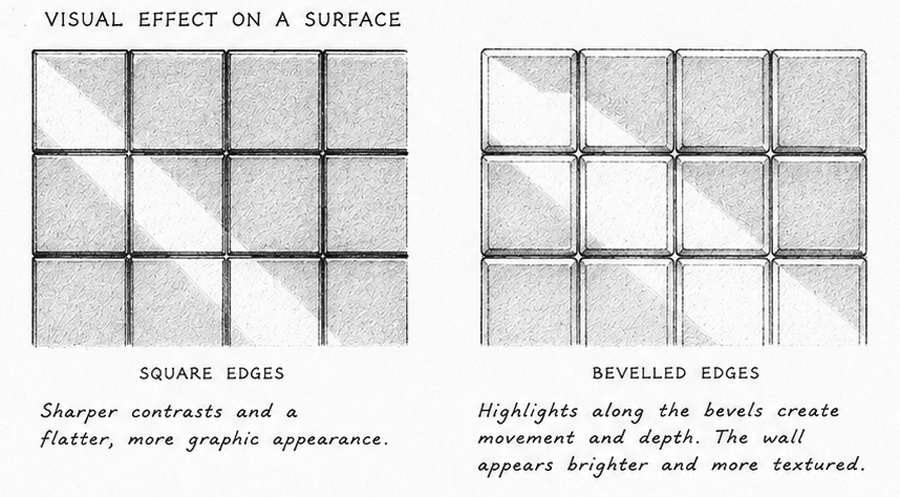
The sloping edge catches light directly, producing highlights and shadow lines around every tile. As a result, the wall becomes more active, rhythmic, and visually textured. Under changing light, bevelled tiles can appear almost luminous.
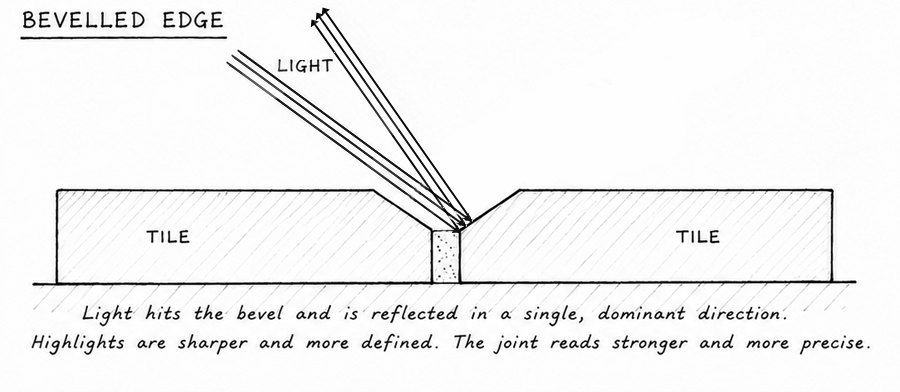
Where cushioned edges calm geometry, bevelled edges emphasise it. The joints become more pronounced, reflections sharper, and the tiled surface acquires a stronger sense of movement and depth. Every tile becomes more distinct from the next.
This is why bevelled metro tiles often appear visually busier than flat wall tiles. The joints themselves become part of the decorative effect.
Bevelled tiles became very popular in the glazed public interiors of the late nineteenth and early twentieth centuries. Underground stations, public bathrooms, butcher shops, and pharmacies all benefited from surfaces that appeared bright, reflective, and visually lively under artificial lighting.
Even today, bevelled tiles retain something distinctly urban and expressive. Their visual character is more graphic than atmospheric, more rhythmic than continuous.
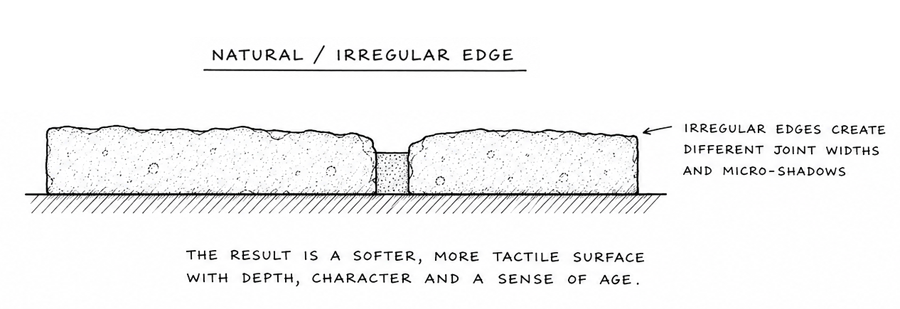
Visually, such edges create a very different effect from industrial ceramic systems. Light does not travel evenly across the surface, but breaks into countless small shadows and highlights. The joints become softer, less predictable, and visually secondary, while the surface itself feels heavier, older, and more tactile.
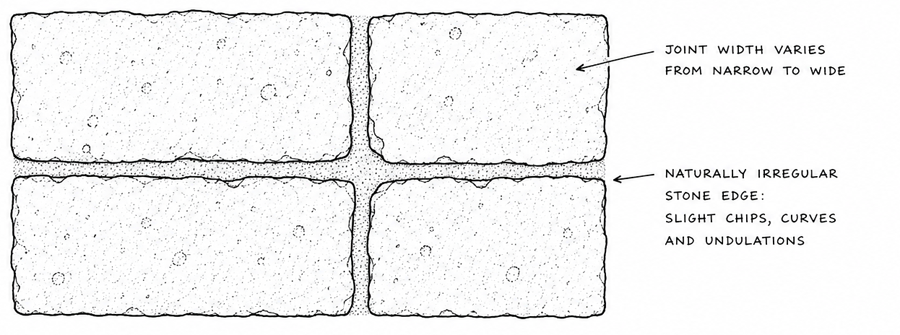
This kind of geometry produces surfaces with material presence and depth rather than precision. Traditional limestone, slate, terracotta, and hand-cut stone floors often derive much of their atmosphere not from pattern alone, but from the irregularity of the edges themselves.
In such surfaces, the grout line stops behaving like a precise graphic element and becomes something more atmospheric. Rhythm replaces exact repetition. This is why narrow joints often feel unnatural here. Attempting to impose mechanical precision upon intentionally irregular surfaces usually weakens their character.
Traditional terracotta, zellige, and handmade ceramics rely on slight variation to create warmth and visual depth. Their beauty lies not in perfect alignment, but in the balance between order and irregularity.
Historically, such edges emerged simply because stone was cut, split, or dressed rather than manufactured to exact dimensions. Yet, much like cushioned ceramics, what began as a practical consequence of traditional production eventually became part of the aesthetic character of the material.
Instead of softening or animating the grid, they attempt to discipline it. Sharp edges minimise the transition between one tile and another, reducing the visual presence of the grout joint and creating flatter, more continuous surfaces.
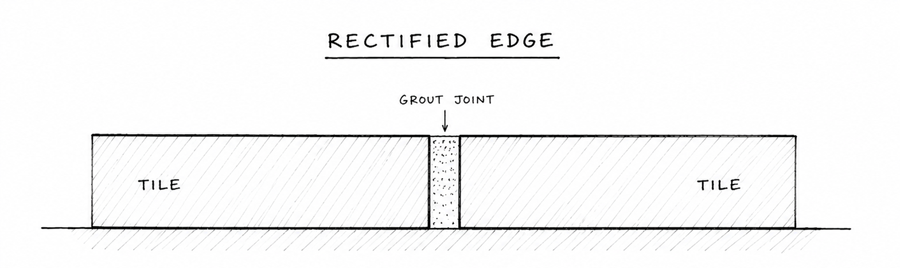
Rectified tiles represent the most precise version of this idea. After firing, they are mechanically cut to exact dimensions, allowing extremely narrow joints and highly controlled geometry. The result is cleaner, sharper, and more architectural.
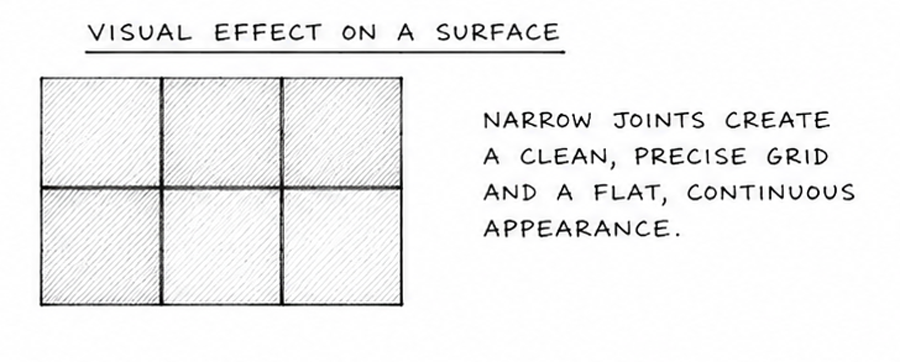
Unlike cushioned or irregular systems, rectified surfaces do not absorb irregularity gracefully; they expose it. Slight deviations in alignment, flatness, or workmanship become immediately visible.
Such surfaces demand precision from both the material and the installer. They look good when the geometry, substrate, lighting, and tile calibration are all disciplined. Otherwise they amplify imperfection rather than conceal it.
Historically, square-edged systems emerged alongside industrial manufacturing and modernist architecture, both of which valued dimensional consistency, planar continuity, and geometric control.
Yet here again, the historical context matters less than the visual effect itself: rectified geometry produces surfaces that feel stricter, quieter, and more abstract than traditional tilework.