
HANDS:
hands
hands title:
§7. Rule 6: Measuring I. Practicalities
hands date:
1 July 2022
hands text:
One accurate measurement is worth
a thousand expert opinions.
a thousand expert opinions.
01
Measuring is a mechanical skill that requires hand–eye coordination and disciplined technique.
Your measurements determine your cuts and the cuts determine the end product. You cannot produce a decent product if your measurements are poor.
02
The most important aspect of measuring is consistency. It therefore does not matter if the tolerances of the current project are forgiving. It is necessary to maintain the correct routine until it becomes second nature. Until such a habit is formed, deliberate effort is required.
03
Not all measuring instruments are equal. In many shops, you can buy, say, a spirit level very cheaply, with an accuracy of, for example, 1.5 mm per metre. Such a level is useless.
Many measuring tools can be checked manually. A spirit level, for instance, should first be levelled against a flat surface and marked. After flipping it 180 degrees and aligning it with the same marks, the bubble should remain in the same position. The greater the distance between the marks, the more accurate the test.
Squares can be checked geometrically using the Pythagorean theorem: a properly constructed triangle should maintain the 3:4:5 relationship. Again, larger triangles reveal smaller inaccuracies more clearly.
04
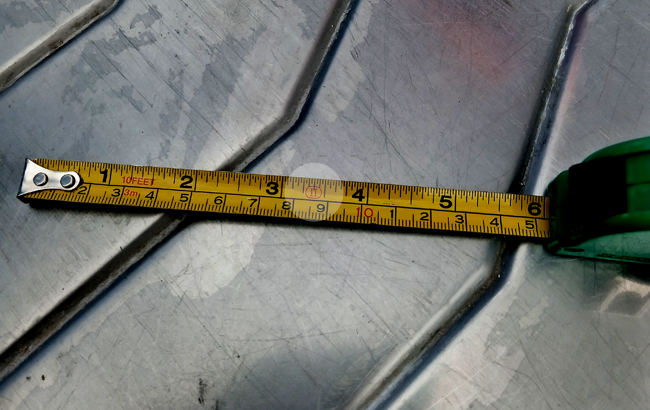
You, however, should know your tolerances and how your tools contribute to the overall result. It is therefore important to have at least one tool with a known level of accuracy. I would suggest that this be a tape measure, the accuracy of which is determined by established standards. In Europe, this is Directive 2014/32/EU.
05
You should always establish a reference point. Switching reference points mid-process compounds error. Once a reference point is chosen, all layouts, marking and checking should proceed from it.
06
I am a great fan of story sticks, templates and all sorts of physical gauges. They eliminate reading errors, parallax and cumulative inaccuracies. When parts relate to one another, transferring size directly from one part to the next is often more accurate than relying on numbers.
07
I trust geometry more than any single measuring tool. I like checking for squareness using the Pythagorean theorem and/or by measuring diagonals.