
On My Way
Press Coffee, Buccleuch Street
How to spoil a perfectly good tiled wall
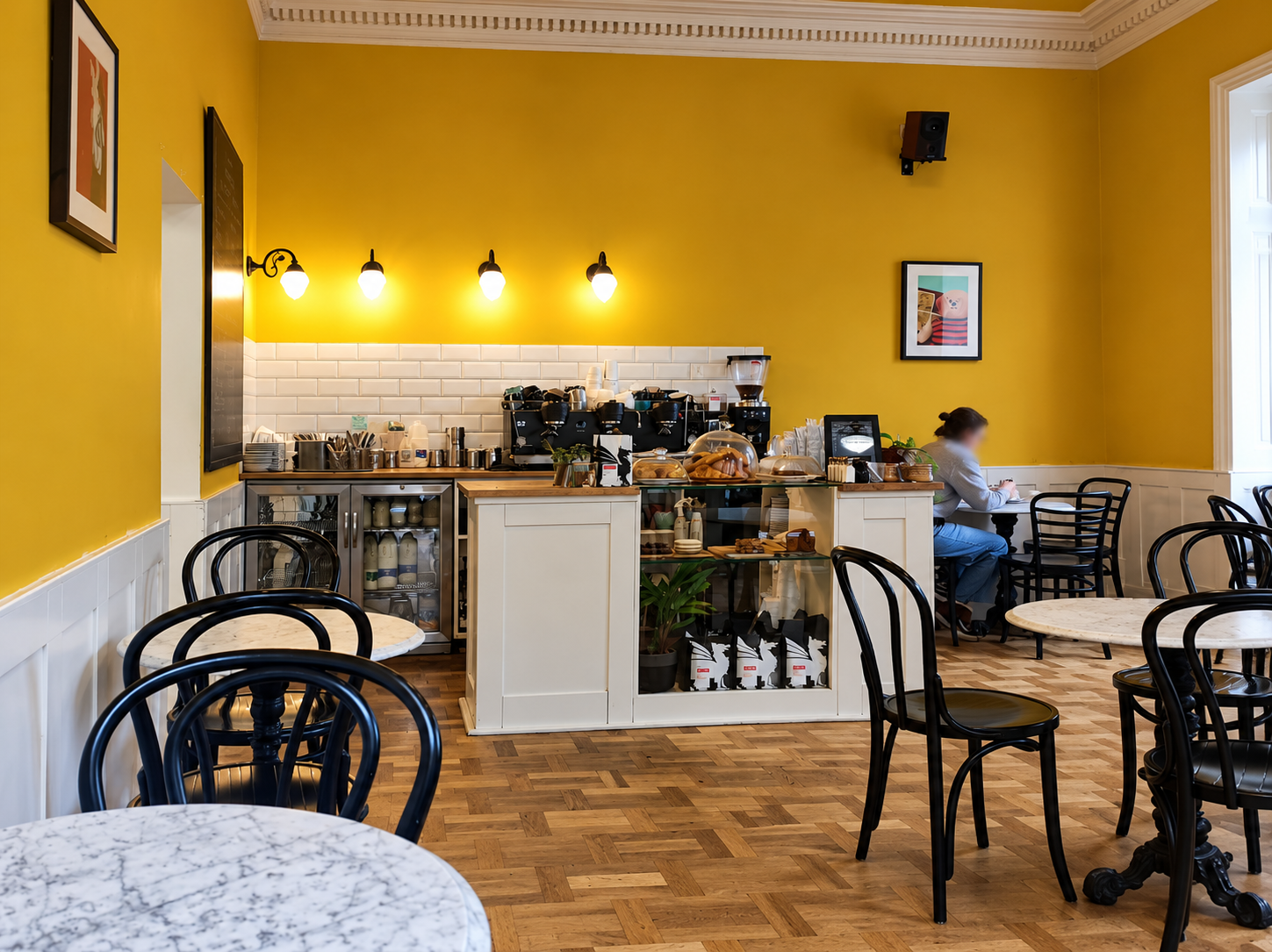
White works well with the yellow, white and red of the room, and white grout makes the metro tiles read more as a textured surface than as a brick pattern. They don't try to be the main feature. There is already enough going on in the room.
And then somebody puts an aluminium trim on top.
Borders have always mattered in tilework. The Romans didn't put them around their mosaics for nothing. An edge doesn't merely finish a surface. It makes the pattern a whole.
Here the trim is stylistically foreign to the room. Against the cornice, parquet, traditional furniture – and the tiles themselves – the profile looks exactly what it is: a tiling accessory. It makes an otherwise restrained surface look cheaper and clumsier than it needs to.
Metro tiles have an edge language of their own. Traditional ranges often include bullnose tiles, cappings, external corners and other finishing pieces. Even when a modern range doesn't have them, these still feel like natural ways for a metro tile to end.
Metal trim introduces something different. With large-format contemporary porcelain, a thin aluminium profile can look perfectly at home. Everything is sharp, precise and modern. Put the same profile on a traditional-looking metro tile and it can feel as though a modern solution has been added to something that speaks a different language.
None of this means no trim with metro tiles. Black or brass can work where metal is already part of the room. Stainless steel can make perfect sense in an industrial interior. In these cases the trim is part of the design rather than something used to finish the job.
For a traditional interior, I would rather see a ceramic finishing piece where the range provides one, a carefully detailed exposed glazed edge or a termination into another architectural element.
And this is what bothers me at Press Coffee. The metro tiles are simple and familiar, which is precisely why they work. But the aluminium trim exposes the system by which they were installed. You stop seeing a tiled wall and start seeing tiles + grout + trim.